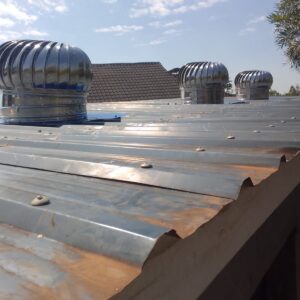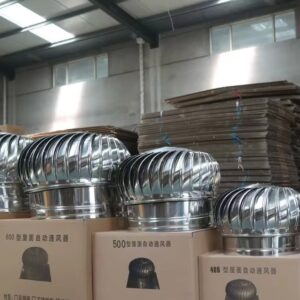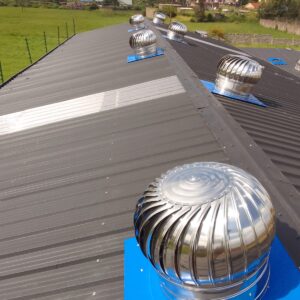
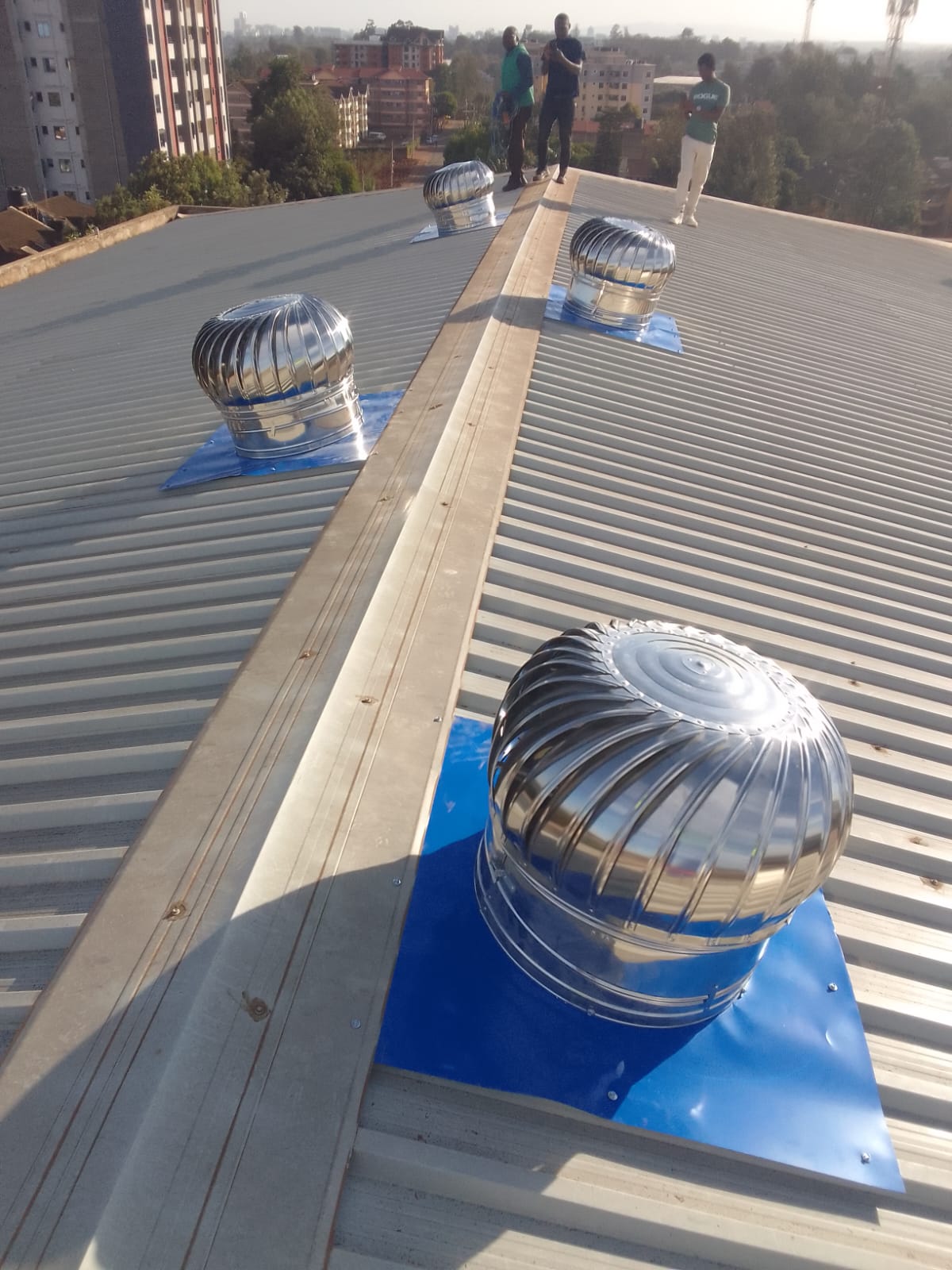
400mm & 500mm Cyclone Roof Ventilators
The middle sizes in our range are the right fit for medium buildings. Our 400mm and 500mm stainless steel cyclone ventilators pull heat, moisture and bad smells out of poultry houses, workshops, classrooms, garages and stores, using only the wind. No electricity, no running costs. Supply only or full installation, anywhere in Kenya.
Description
400mm and 500mm Roof Ventilators: The Right Size for Medium Buildings
A 500mm roof ventilator is one of the most popular sizes in Kenya, and the 400mm comes close behind. Why? Because most buildings are neither tiny nor huge. Poultry houses, workshops, classrooms, garages and stores all sit in the middle.
For these buildings, a small ventilator is too weak, while a 600mm unit may be more than you need. Therefore, the 400mm and 500mm sizes give the best balance of airflow, cost and appearance.
400mm or 500mm: Which One Should You Choose?
Both sizes work the same way. However, they suit slightly different buildings.
Choose 400mm if:
- First, your building is small to medium, such as a single classroom, a small workshop or a shop.
- Second, the roof is fairly low or the space doesn’t produce much heat.
- Also, you want a neat, smaller unit on the roof.
Choose 500mm if:
- First, your building is medium to large, such as a long poultry house, a garage or a store.
- Second, there’s a lot of heat, moisture or smell, for example from birds, vehicles or machines.
- Also, you want fewer units to cover the roof.
Still unsure? Send us your building size on WhatsApp, and we’ll tell you which size fits best.
Where 400mm and 500mm Ventilators Work Best
These sizes suit a wide range of buildings. For example:
- Poultry houses: because they remove heat, moisture and ammonia smell, so birds stay healthier
- Classrooms and dormitories: so learners stay alert in the afternoon heat
- Workshops, garages and kitchens: to clear welding fumes, paint smells, cooking smoke and engine heat
- Shops and small stores: where stock needs protection from heat and damp
- Small warehouses and farm stores: including feed stores and produce stores
On the other hand, for very large roofs, see our 600mm Cyclone Roof Ventilator. Likewise, for homes and small rooms, see Roof Ventilators for Homes. For all sizes in one place, see the Stainless Steel Cyclone Roof Ventilator.
Benefits of Our 400mm and 500mm Ventilators
- Strong extraction for medium spaces, so heat doesn’t build up under the roof
- Removes moisture and condensation, which helps stop dripping roofs, rust and mould
- Clears smells and fumes, especially ammonia in poultry houses and fumes in workshops
- No electricity needed, therefore zero running costs, even during power cuts
- Stainless steel, so it resists rust for years
- Low maintenance, because there’s no motor to burn out
- Quiet operation, which matters in classrooms and homes nearby
How Many Do You Need?
As a general guide, plan for one ventilator for every 20–30 m² of roof. However, hot or busy buildings need the higher number.
For example, a 15m × 8m poultry house is 120 m². 120 ÷ 30 = 4, and 120 ÷ 20 = 6. Because chickens produce heat, moisture and ammonia, plan for about 6 ventilators.
For the full step-by-step method, read: How Many Roof Ventilators Do I Need in Kenya?
Your Common Questions Answered
Will it leak when it rains?
No, as long as it’s installed properly. In addition to the ventilator’s rain-proof design, our installers seal the base carefully to the roof.
Does it work when there’s no wind?
Yes. Hot air rises naturally, so it escapes even on calm days. Meanwhile, any breeze makes it spin faster and pull more air out.
Is it suitable for a poultry house with chicks?
Yes. However, ventilation for young chicks must be balanced with warmth. For this reason, we advise on the right number and position for brooding houses. For more, see Poultry House Ventilation.
Professional Installation Available
You can buy the ventilators only, or let our team install them:
- First, we assess your roof and how the building is used.
- Next, we recommend the right size and number.
- Then we cut, fit and seal each unit.
- Finally, we check that every ventilator spins freely and the roof is watertight.
To learn more, see: Cyclone Roof Ventilator Installation in Kenya and East Africa
Even Cooler: Add Roof Insulation
Ventilators remove hot air once it has built up. In contrast, insulation stops much of the sun’s heat from coming through the roof. As a result, buildings with both stay much cooler, especially poultry houses and classrooms with iron sheet roofs.
See: Roof Insulation Services with PE Foam in Kenya
For Hardware Shops and Contractors
The 400mm and 500mm sizes sell well in hardware shops and to farmers. Therefore, we supply them in bulk at trade rates.
See: Wholesale Cyclone Roof Ventilators for Resellers
How to Order
- First, send us your building size, use and location on WhatsApp.
- Next, we recommend 400mm or 500mm, and how many you need.
- Then you receive your quote, with or without installation.
- Finally, we deliver or install, anywhere in Kenya.
📞 +254 722 664 867 | 💬 Chat on WhatsApp | 📧 info@bioflexinsulationlimited
The 500mm is larger, so it moves more air. Therefore, it suits bigger or hotter buildings, while the 400mm suits smaller spaces.
Roughly, yes. 500mm is about 20 inches, and 400mm is about 16 inches.
Most poultry houses do well with 500mm ventilators. However, small or brooding houses may suit 400mm. In any case, we advise based on your house size.
Yes. 400mm is a good fit for single classrooms. Similarly, 500mm suits larger halls and dormitories.
As a guide, about one per 20 m² of roof. For example, a 120 m² poultry house needs about 6.
No. They run on wind and rising hot air, so there are no running costs.
They’re made of stainless steel. As a result, they resist rust far better than ordinary metal.
Yes. We deliver and install across Kenya, and also serve clients in East Africa. 1. What is the difference between a 400mm and a 500mm roof ventilator?
2. Is 500mm the same as 20 inch?
3. Which size is best for a poultry house?
4. Can I use 400mm ventilators on a classroom?
5. How many 500mm ventilators does a poultry house need?
6. Do they need electricity?
7. Will they rust?
8. Do you deliver outside Nairobi?