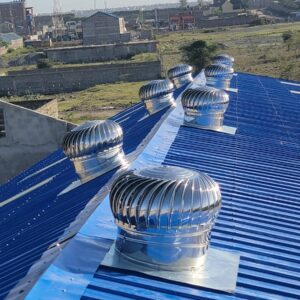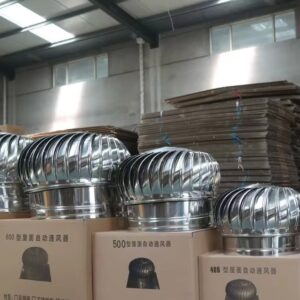
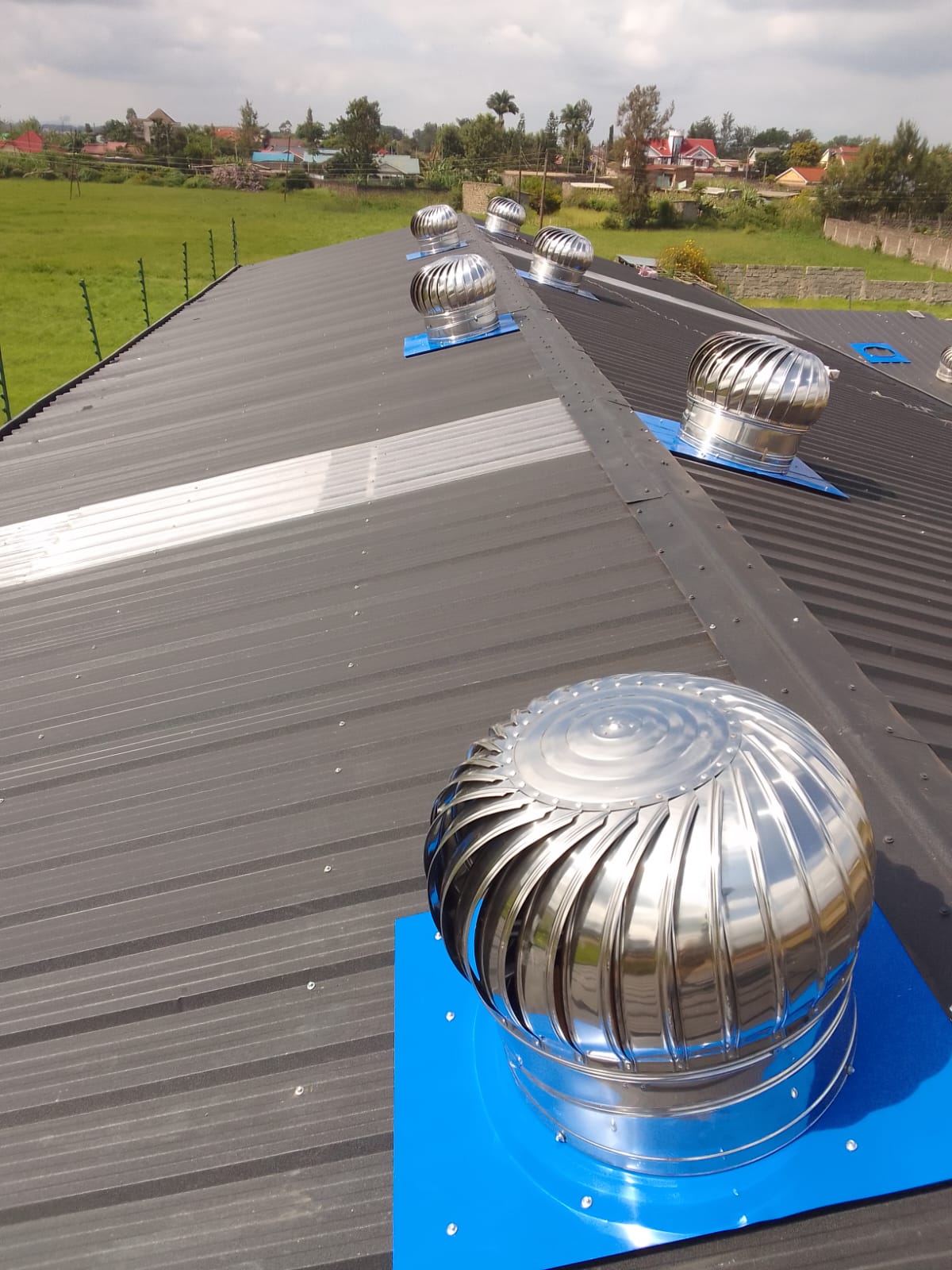
Warehouse & Factory Roof Ventilators
Keep your godown, factory or store cooler and drier without adding to your power bill. Our stainless steel roof ventilators pull heat, condensation, fumes and dust out from the top of the building, using only the wind. As a result, your stock is better protected and your workers are more comfortable. Supply and professional installation across Kenya.
Description
Warehouse Ventilation in Kenya: Protect Your Stock and Your People
Warehouse ventilation is one of the simplest ways to protect the two things every business depends on: your stock and your people. In Kenya, most godowns and factories have large iron sheet or box profile roofs. Under the sun, these roofs heat up fast.
As a result, hot air collects under the roof and spreads down into the working area. On top of that, machines, lights, vehicles and workers all add heat. Without a way for that hot air to escape, the building becomes an oven by midday.
Problems Poor Warehouse Ventilation Causes
When a warehouse or factory can’t breathe, you start to see:
- Damaged stock, for example softened packaging, melted products, or cartons weakened by heat and damp
- Condensation dripping from the roof onto goods, especially on cold mornings
- Mould, rust and bad smells, because moisture has nowhere to go
- Fumes and dust hanging in the air in factories and processing areas
- Tired, uncomfortable workers, which leads to slower work and more mistakes
Moreover, Section 49 of the Occupational Safety and Health Act, 2007 requires adequate ventilation in workplaces. So good airflow also helps you stay compliant. For more warning signs, see Signs Your Building Has Poor Ventilation.
How Roof Ventilators Solve It
First, hot air, fumes and moisture rise to the highest point of the roof. Then the spinning cyclone ventilators pull them out continuously. Meanwhile, fresh air enters through doors, windows and wall openings.
As a result:
- The roof space stays cooler, so less heat reaches stock and workers
- Condensation reduces, which helps protect goods, roofing and steel structures
- Fumes, dust and smells clear faster
- All this happens without electricity, therefore there are no running costs, even during power cuts
Businesses That Benefit from Better Warehouse Ventilation
Our ventilators suit almost any large building. For example:
- Godowns and distribution warehouses: FMCG, electronics, textiles, packaging
- Grain, feed and produce stores: where dry air helps protect produce from damp
- Factories and processing plants: food processing, plastics, metal works, printing
- Hardware and building material stores: cement, paint, timber
- Logistics depots: loading bays and dispatch areas
- Mitumba and wholesale stores: where heat and stale air build up quickly
Does your factory also have a kitchen, canteen or welding section? If so, see Kitchen and Workshop Fume Extraction.
Which Ventilator Size Do Warehouses and Factories Need?
For most industrial roofs, 600mm ventilators give the best result, because they move the most air per unit. However, 500mm suits smaller stores, or buildings with lower roofs.
To compare sizes, see our 600mm Cyclone Roof Ventilator and 400mm and 500mm Roof Ventilators. For all sizes in one place, see the Stainless Steel Cyclone Roof Ventilator.
How Many Ventilators Does a Warehouse Need?
As a general guide, plan for one ventilator for every 20–30 m² of roof. However, factories with machines or heat-producing processes should use the higher number.
For example, a 30m × 20m warehouse is 600 m². Using smaller ventilators, that’s about 20–30 units. With 600mm units, the number is usually lower.
For the full method, read: How Many Roof Ventilators Do I Need in Kenya? For more ways to cool a building, see How to Reduce Heat in a Warehouse or Factory in Kenya.
Installed Without Stopping Your Operations
Because we work from the roof, your business can usually keep running while we install:
- First, we visit, assess the roof and check the heat sources inside.
- Next, we plan the number, size and placement of ventilators.
- Then we cut, fit and seal each unit, working safely at height.
- Finally, we check that every ventilator spins freely and the roof is watertight.
To learn more, see: Cyclone Roof Ventilator Installation in Kenya and East Africa
Your Common Questions Answered
Will cutting holes in my roof cause leaks?
No, as long as the job is done properly. For this reason, our installers seal every base carefully. In addition, the ventilators are designed to keep rain out.
Can ventilators replace electric extractor fans?
In many warehouses, yes. However, where there are heavy fumes or specific airflow needs, roof ventilators and fans can work together. Either way, we’ll advise you honestly. See our Exhaust Ventilation Fan.
Do they work on calm days?
Yes. Hot air rises naturally, so it escapes even without wind. Meanwhile, any breeze makes the ventilators spin faster.
Go Further: Insulate the Roof Too
Ventilators remove heat that has already built up. In contrast, roof insulation stops much of the sun’s heat from entering through the iron sheets. Consequently, warehouses with both stay much cooler, and condensation drops even further.
See: Roof Insulation Services with PE Foam in Kenya
Why Businesses Choose Bioflex for Warehouse Ventilation
- Stainless steel ventilators, built to last on industrial roofs
- Honest sizing advice, so you buy only what you need
- An experienced team, trained for safe work at height
- One supplier for ventilation, insulation, cold rooms and industrial chemicals
- Many completed jobs on warehouses and factories in Nairobi and beyond
Are you a contractor fitting out several buildings? See Wholesale Cyclone Roof Ventilators for Contractors.
How to Order
- First, send us your building size, what it stores or produces, and its location on WhatsApp.
- Next, we arrange a site visit or recommend from your details.
- Then you receive your quote, with or without installation.
- Finally, we install at a time that suits your operations.
📞 +254 722 664 867 | 💬 Chat on WhatsApp | 📧 info@bioflexinsulationlimited.co.ke
Frequently Asked Questions
1. What is the best warehouse ventilation in Kenya?
For most warehouses, roof ventilators are the simplest choice, because they remove hot air from the highest point without any electricity.
2. Do roof ventilators reduce condensation in warehouses?
Yes, they help. By pulling moist air out, they reduce how much water forms under the roof. For the best result, combine them with roof insulation.
3. Which ventilator size is best for a factory?
600mm suits most factories and large warehouses. However, 500mm works for smaller stores or lower roofs.
4. How many ventilators does a 600 m² warehouse need?
About 20–30 using the general guide, or fewer with 600mm units. In any case, a site visit confirms the right number.
5. Can you install while my warehouse is operating?
Usually, yes. Because we work from the roof, most businesses keep running during installation.
6. Do roof ventilators remove fumes and dust?
Yes, they help clear fumes and fine dust that rise to the roof. However, heavy fume sources may also need extractor fans.
7. Do I need electricity to run them?
No. They run on wind and rising hot air, so there are no running costs.
8. Do you serve warehouses outside Nairobi?
Yes. We install across Kenya, and also serve clients in East Africa.