Insulated Packaging Boxes in Kenya: 6 to 41 Litres, All Sizes
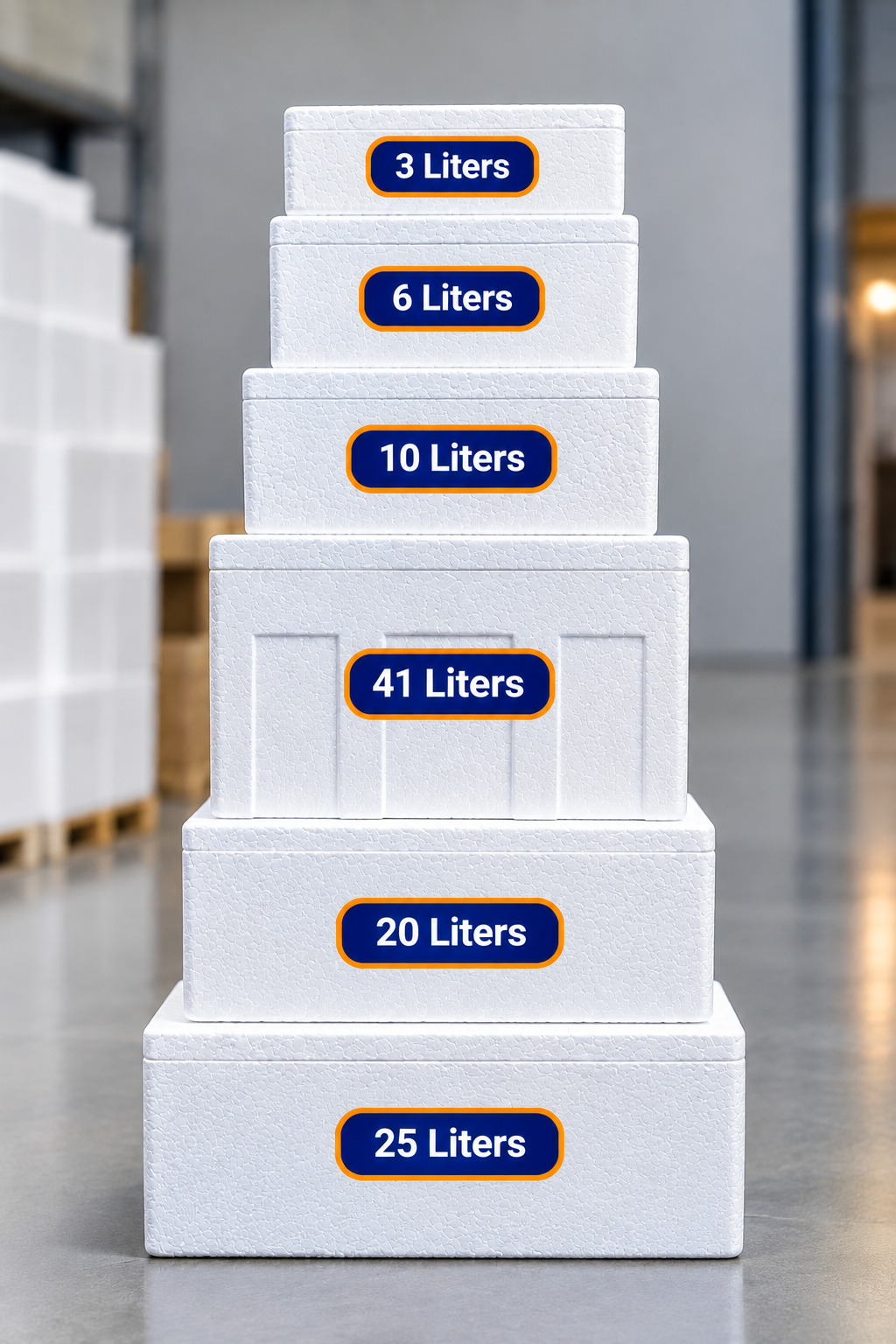
Insulated packaging boxes that keep your fish, meat, food and medicine cold during storage and transport. Choose from six sizes, from a small 6 litre box to a large 41 litre box, all with lids.
- Six sizes, from about 6 to 41 litres (sold as 3kg, 6kg, 10kg, 20kg, 25kg and 41kg)
- Every box comes with a lid
- Food-grade material, safe for food and medicine
- Light, strong and reusable
- Single boxes or bulk orders
- Delivery across Kenya and East Africa
Description
Insulated Packaging Boxes That Keep Things Cold
Do you need a packaging box that keeps fish fresh, meat cold or medicine safe on the way to your customer? If so, you need an insulated packaging box. These white boxes have thick, light foam walls and a tight lid. As a result, they keep the cold in and the heat out for hours. That way, your products arrive as fresh as they left.
People call these boxes by many names. For example, you may know them as cooler boxes, ice boxes, cold boxes, foam boxes, fish boxes or simply “the white box with a lid.” In the trade, they’re also called styrofoam, thermocol, polystyrene or EPS boxes. However, all these names describe the same thing: a light, insulated box that keeps contents cold.
Why Your Products Need Insulated Packaging
Heat spoils fresh products fast. In fact, in Kenyan weather, fish, meat, milk and some medicines start losing quality within hours in an ordinary bag, bucket or carton. An insulated box, however, slows that down. Because the foam walls trap tiny pockets of air, heat struggles to get through. Therefore, ice and ice packs last much longer inside. As a result, your goods stay cold until they reach the customer.
In short, insulated packaging protects three things: the quality of your products, your customers’ trust and, above all, your profit.
All Six Sizes at a Glance
| Size | Capacity | Wall thickness | External (L × W × H) | Internal (L × W × H) | Best for |
|---|---|---|---|---|---|
| 3kg | about 6 litres | 25mm | 40 × 30 × 10 cm | 36 × 26 × 6 cm | Lab samples, insulin, vaccines, breast milk |
| 6kg | about 8 litres | 25mm | 40 × 30 × 14 cm | 35 × 25 × 9 cm | Small fish and meat orders, home deliveries |
| 10kg | about 13 litres | 25mm | 40 × 30 × 23 cm | 34 × 24 × 16 cm | Catering, dairy rounds, events |
| 20kg | about 35 litres | 25mm | 58 × 33 × 25 cm | 53 × 33 × 20 cm | Daily bulk fish, meat and poultry |
| 25kg | about 38 litres | 37mm | 67 × 47 × 23 cm | 60 × 40 × 16 cm | Large bulk loads, long routes, export |
| 41kg | about 41 litres | 40mm | 46 × 40 × 39 cm | 40 × 33 × 31 cm | The heaviest loads, temporary cold storage |
External dimensions are the outside of the box with the lid on, so use them to plan space in your vehicle or store. Internal dimensions are the usable space inside, so use them to check that your products and ice will fit. Also, the 25kg and 41kg boxes have thicker walls (37mm and 40mm), which helps them hold the cold longer on long journeys. Every size comes with a lid and is made from food-grade material.
Cooler Box Sizes in Litres
In Kenya, we sell our boxes by kilos, such as a 6kg or 25kg box, because that’s how traders buy them. However, if you’re used to cooler boxes measured in litres, here’s how they compare:
- Small, about 6 to 8 litres (3kg and 6kg): these suit samples, medicine, a few bottles or a small fish order.
- Medium, about 13 litres (10kg): this size works well for a catering order, a dairy round or drinks for a family outing.
- Large, about 35 to 41 litres (20kg, 25kg and 41kg): in contrast, these are made for bulk fish, meat, produce and event ice.
Keep in mind that the litres show the total space inside. In practice, however, you’ll fill part of that space with ice. So choose a box a little bigger than your products alone.
Also, the boxes differ in shape. For example, the 25kg box is long and flat, so it suits fish laid out in layers. The 41kg box, on the other hand, is deeper and more upright. As a result, it suits stacking ice and bulk stock.
Which Size Should You Choose?
First, think about how much you carry on a normal day. Then match it to a size, leaving some room for ice. As a simple guide:
- Carrying for yourself or one customer? In that case, choose the 6 litre (3kg) or 8 litre (6kg) box.
- Delivering to several customers or serving an event? Then the 8 litre (6kg) or 13 litre (10kg) box is best.
- Moving stock to a market or hotel every day? For this, choose the 35 litre (20kg) or 38 litre (25kg) box.
- Moving bulk from a farm or landing site, or short of fridge space? In that case, choose the 38 litre (25kg) or 41 litre (41kg) box.
Remember, a full box stays colder than a half-empty one. So always choose the size your load fills. For a deeper comparison, read our styrofoam box sizes guide.
Who Uses Insulated Packaging Boxes?
- Fish vendors and traders: first and foremost, they use packaging boxes for fish from the lake or the coast to markets and customers. See our insulated fish boxes.
- Butchers and poultry sellers: similarly, they keep meat and chicken cold during delivery.
- Clinics, labs and pharmacies: in addition, they need cold packaging for samples, vaccines and medicine. See our medical and vaccine boxes.
- Caterers and hotels: likewise, they keep food cold, or hot, from the kitchen to the event.
- Farmers and exporters: meanwhile, they protect fruit, vegetables and herbs from heat and bruising.
- Online shops and delivery businesses: also, they use chilled packaging for groceries, cakes and cosmetics.
- Families: finally, families use them as cool boxes for picnics, road trips and outdoor events.
How to Pack an Insulated Box for the Longest Cold
- First, chill your products before packing.
- Next, put a layer of ice or ice packs at the bottom.
- Then add your products. For fish and meat, also add layers of ice in between.
- After that, cover the top with more ice.
- Finally, fill any gaps, close the lid tightly and keep the box in the shade.
Insulated Boxes vs Other Packaging
- Compared with cartons: cardboard soaks up water and lets heat through. An insulated box, however, holds ice and keeps the cold in.
- Compared with buckets and basins: open containers warm up quickly. In contrast, an insulated box with a lid keeps fish cold for hours.
- Compared with hard plastic coolers: plastic coolers cost much more and weigh more. Insulated foam boxes, on the other hand, are light and affordable. Therefore, you can send them with the order.
Are the Boxes Reusable?
Yes. In fact, with care, you can use the same box many times. After each use, rinse it with clean water and mild soap. Then let it dry with the lid off, which also stops smells. However, avoid sharp objects and heavy weights on top, because they can crack the foam.
How to Order and Where to Buy
Ordering is simple:
- First, WhatsApp us the sizes and quantities you need.
- Next, we send you a quote.
- Finally, you collect from our Industrial Area shop, or we deliver to you.
You’ll find Bioflex Insulation Limited in Industrial Area, Nairobi, open Monday to Saturday, 8am to 5pm. Similarly, Nairobi deliveries run Monday to Saturday, 8am to 5pm. For other Kenyan counties, Uganda, Tanzania and the rest of East Africa, however, WhatsApp us for your delivery date.
Better still, you can mix sizes in one order. To browse every product in the range, see our styrofoam boxes for sale in Kenya.
Frequently Asked Questions
1. What are insulated packaging boxes made of?
We make them from food-grade EPS (expanded polystyrene), a light foam full of tiny air pockets that block heat.
2. Is a cooler box the same as a styrofoam box?
Often, yes. Many people call our white foam boxes cooler boxes, ice boxes or foam boxes. They all mean the same insulated box.
3. How many litres is a 6kg styrofoam box?
Our 6kg box holds about 8 litres. For every size, see the table above.
4. What is the biggest cooler box you sell?
Our largest standard box is the 41kg size, which holds about 41 litres. For bigger needs, ask us about a custom size.
5. Why are your boxes sold in kg instead of litres?
In Kenya, traders usually buy boxes by how much fish or produce they carry, so we name them in kilos. However, we list the litres for every size so you can compare.
6. How long do the boxes keep things cold?
It depends on the amount of ice, the outside heat and how often you open the lid. With ice and the lid closed, the boxes keep contents cold for hours.
7. Are the boxes safe for food and medicine?
Yes. We make every box from food-grade material, safe for fish, meat, dairy, fresh produce, samples and medicine.
8. Do all the boxes come with lids?
Yes. Every box, in every size, comes with its lid.
9. Can I buy just one box?
Yes. We sell single boxes as well as bulk orders.
10 Can you make a custom size?
If none of the six sizes fits your product, WhatsApp us your measurements and ask about a custom size.
11. Do you deliver outside Nairobi?
Yes. We deliver across Kenya’s counties and to Uganda, Tanzania and the rest of East Africa
12. How much do insulated packaging boxes cost?
Prices depend on the size, the quantity and your delivery location. WhatsApp us and we’ll send a quick quote.