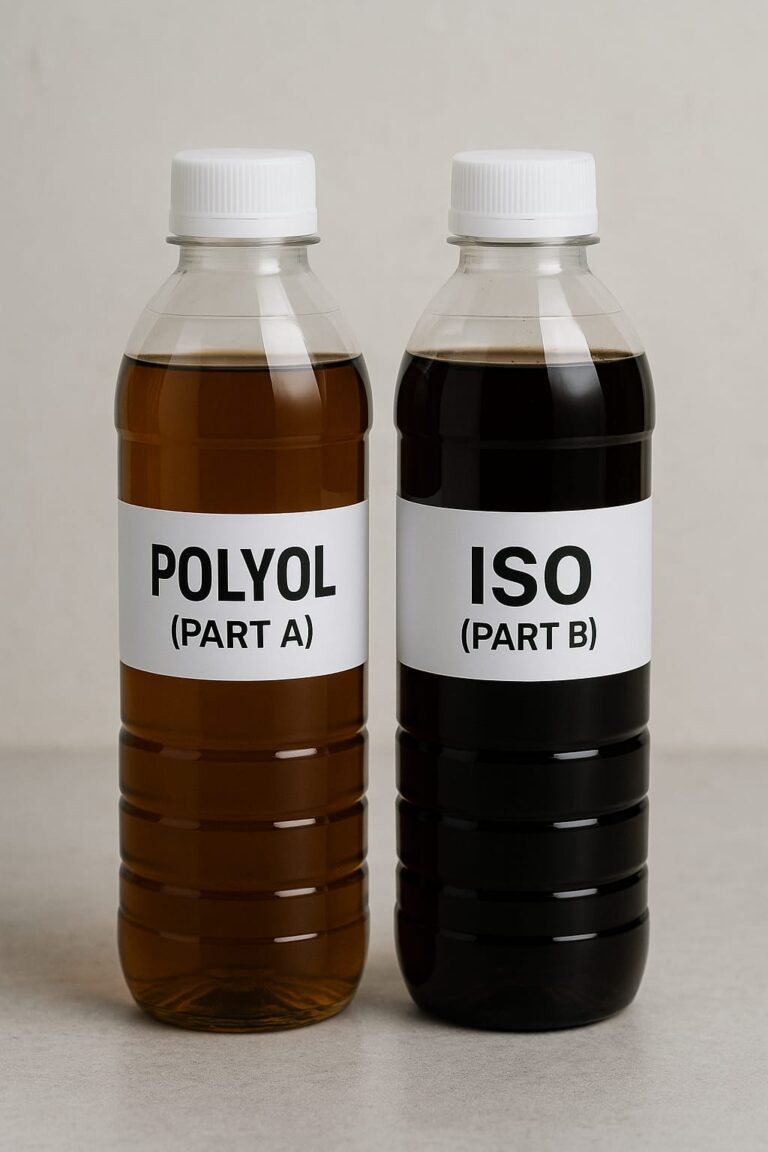

Mixing Ratio for Polyol and Isocyanate PU Foam: Common Formulas and Mistakes
Every high-quality polyurethane (PU) foam product starts with one critical factor — the mixing ratio between Polyol and Isocyanate. Whether you’re insulating cold rooms, tanks, or industrial roofs, the right balance determines how well your PU foam performs.
At Bioflex Insulation Ltd, we help contractors and engineers across Kenya and East Africa achieve consistent, energy-efficient results by using correctly balanced Polyol and Isocyanate PU foam systems.
Why the Mixing Ratio Matters
The chemical reaction between Polyol and Isocyanate creates rigid polyurethane foam. When the ratio is balanced, the mixture expands evenly and forms a closed-cell structure that traps air and prevents heat transfer.
An incorrect ratio, however, affects foam quality and durability. Too much Polyol produces soft or spongy foam. Too much Isocyanate causes brittleness, shrinkage, or cracking. Therefore, accuracy during mixing is essential for insulation that lasts.
Standard Polyol and Isocyanate Ratios
Most two-component PU foam systems use a 1:1 mixing ratio by volume. This balance ensures a complete reaction between the two components.
In industrial applications, technicians sometimes fine-tune the ratio slightly depending on:
- Desired foam density
- Application method (spray, pour, or inject)
- Temperature and humidity during installation
Professional spray machines control both temperature and pressure, maintaining the correct ratio automatically. This consistency is key to achieving uniform thickness, proper adhesion, and stable foam density.
Common Mixing Mistakes and How to Avoid Them
1. Inaccurate Measuring
Using manual containers or guessing the ratio leads to a chemical imbalance. Always rely on calibrated spray equipment.
2. Poor Temperature Control
Cold surfaces or unheated components delay reaction and cause uneven expansion. Maintain proper spray temperature — usually between 20–25°C.
3. Humid Conditions
Moisture reacts with Isocyanate and forms gas bubbles. Ensure surfaces are dry before mixing and spraying.
4. Inadequate Mixing Time
If Polyol and Isocyanate are not blended long enough, the foam may remain sticky or soft. Mix thoroughly until the texture is uniform.
By avoiding these mistakes, contractors can produce PU foam that’s consistent, strong, and long-lasting — ideal for Kenya and East Africa’s demanding environments.
For further information on polyurethane standards, visit the International Association of Polyurethane Manufacturers.
Best Practices for Professionals
- Use mechanical or automated mixing systems for accuracy.
- Calibrate equipment before every job.
- Record mix ratios, ambient temperature, and humidity for quality control.
- Apply foam in thin, even layers to avoid over-expansion.
- Always wear protective gear, including gloves, goggles, and masks.
At Bioflex Insulation Ltd, our technical team provides training and on-site guidance to ensure correct mixing and application every time.
Related Reading
Learn more in our detailed guide, Polyol and Isocyanate PU Foam in Kenya & East Africa – Complete Guide.
You may also like: Polyol vs Isocyanate: What’s the Difference and Why It Matters.
Conclusion
Correct mixing of Polyol and Isocyanate is the foundation of strong, reliable PU foam insulation. When properly balanced, the foam adheres firmly, resists moisture, and delivers long-term energy efficiency.
For expert supply, advice, or installation services across Kenya and East Africa, contact Bioflex Insulation Ltd +254722664867— your trusted partner in polyurethane insulation solutions.